Home Heating Safety
Heating equipment is the leading cause of home fires during the months of December, January, and February. Click here to read more important information and tips on how to safely heat your home.
Follow LFD on TWITTER
The Lexington Fire Department is now trying out TWITTER! We will use this medium to pass on Fire Safety Tips, Fire Update, and other Lexington Fire Department Information to all who are interested.
Click here to follow us! - (LexingtonFire)
Carbon Monoxide - The Silent Killer
This time of year, dangers from carbon monoxide is of particular concern. As the mercury begins to dip, some families, struggling to pay their heating bills, will turn on the kitchen stove burners and the oven in an effort warm up their home. What these families don’t realize is how dangerous this practice can be. A gas oven or range top should never be used for heating. A fire could start and poisonous carbon monoxide (CO) fumes could fill the home.
Any fuel-burning heating equipment (fireplaces, furnaces, water heaters, space or portable heaters), generators and chimneys can produce carbon monoxide. If these forms of heating are not properly ventilated CO poisoning can result.
According to the National Fire Protection Association (NFPA) there is an increased risk of dying in a home fire during the winter season. December, January and February are generally the deadliest months for fire.
Often called a silent killer, CO is an invisible, odorless, colorless gas created when fuels, such as gasoline, wood, coal, natural gas, propane, oil and methane, burn incompletely.
CO enters the body through breathing. CO poisoning can be confused with flu symptoms, food poisoning and other illnesses. Some symptoms include shortness of breath, nausea, dizziness, light headedness or headaches.
Everyone is at risk for CO poisoning, but infants, pregnant women and people with physical conditions that limit their ability to use oxygen, such as emphysema, asthma or heart disease, can be more severely affected by low concentrations of CO than healthy adults. High levels of CO can be fatal for anyone, causing death within minutes.
The goal of the Lexington Fire Department is to reduce the number of carbon monoxide incidents in Fayette Countyand discourage anyone from using the range or oven to heat their home. Install CO alarms inside your home to provide early warning of accumulating CO. Have your heating equipment inspected by a professional every year before cold weather sets in. Use generators outdoors away from all doors and windows and vents.
- CO alarms are not substitutes for smoke alarms. Know the difference between the sound of smoke alarms and CO alarms.
- Test CO alarms at least once a month.
- If your CO alarm sounds, immediately move to a fresh air location outdoors or by an open window and doors and call for help.
- Remain at the fresh air location until emergency personnel say it is okay.
- If the audible trouble signal sounds, check for low batteries or other trouble indicators.
The Lexington Fire Department wants everyone to be warm and safe this winter. Make sure your home has carbon monoxide alarms.
Two New Special Operations Apparatus Enter Front Line Service

Hazardous Materials One (HM1)

Heavy Rescue One (RS1)
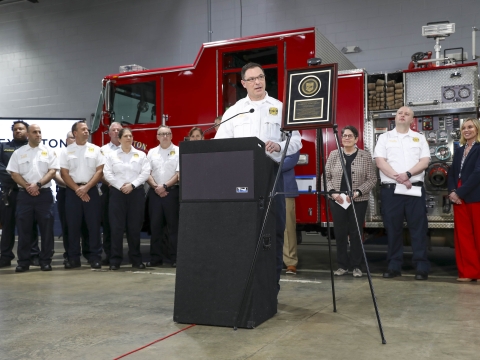
In November new replacements for Hazardous Materials One and Heavy Rescue One went into front line service. As their names imply these vehicles provide specialized equipment and personnel for highly technical and demanding emergency situations.
Hazardous Materials One (HM1) was purchased with a $600,000 grant award from the Kentucky Department of Homeland Security in 2008. Heavy Rescue One (RS1) was ordered with local funds in 2008 at a cost of $600,000. Because both vehicles are customized it took almost a year to build each of them. Both vehicles have retractable light masts and vehicle mounted scene lighting, slide out equipment trays that increase storage capacity as well as improve ergonomics, and engine/transmission/exhaust systems that reduce environmental impact. Of special note with HM1 are the enclosed two person research station and environmental monitoring equipment. RS1 features under the chassis slide out storage trays and two immediately available extrication tools mounted on the front bumper.
HM1 and RS1 represent a significant improvement to our hazardous materials and technical response resources. They join forces with our specialized Haz Mat Engine and Ladder companies to provide the largest contingent of immediately available special operations resources within the Commonwealth. These, along with Command Post One, Mass Casualty One, and a variety of other pre-staged equipment are available to respond to any emergency at the local, regional, or state level.
THE LEXINGTON FIRE DEPARTMENT
IS THANKFUL FOR
FIRE SAFETY THIS THANKSGIVING
During the holidays, the process of deep frying a turkey can be tasty, but also dangerous. The instructions provided with the cooker should be read carefully before attempting to deep-fry a turkey. This is critical in order to prevent a serious fire or burn injury... read more
Open Burning Permits...
The Division of Fire is administering the Open Burning Permit program a little differently now. You can download and read the new regulations, and an application form here. After filling in the form (online if you wish) you can save it to your hard drive for your reference, then attach the saved file to an email to submit it directly instead of driving downtown. Of course you can also fill it in online, then print and mail it.
Please take the time to read the regulations - they will save you a lot of time and money, and make the whole permit process run more smoothly for everybody. To that end, there is a link at the bottom of each page in the set to get to the next page. Only the last page of the regulations has a link to the actual application. The whole thing opens up in a new browser window, so when you are done, just close the window to come back here and browse more of the LFD website.
To apply, click here....